
Your customers are asking AI where to find you. Are you showing up?
Search isn't a list of blue links anymore. Here's what changed, why it matters for small businesses in Columbus and beyond, and the five things you can do about it this month.
Something changed in how your customers find businesses like yours — and most small business owners haven't been told about it.
When someone needs a caterer, a plumber, a marketing consultant, or a good accountant, they used to type something into Google and scroll through results. Some still do. But more and more, they're asking ChatGPT, Perplexity, Google's AI Overview, or Siri a direct question — and getting a direct answer back. No list of ten websites. No scrolling. Just: here's who you should call.
If your business isn't in that answer, you don't exist for that buyer.
That's the shift. And it has a name: Answer Engine Optimization, or AEO. This post explains what it is, why it matters right now, and what a small business owner can actually do about it — without a technical background or a big budget.
What is Answer Engine Optimization and why does it matter in 2026?
Traditional SEO — Search Engine Optimization — was about getting your website to rank high in Google search results so people would click on it. That still matters. But something new is sitting on top of it.
Answer Engine Optimization (AEO) is the practice of making your content easy for AI tools to find, understand, and use when they're generating an answer for someone's question. Instead of optimizing to rank, you're optimizing to be cited. Instead of competing for position 1 on a results page, you're competing to be the source an AI summarizes when someone asks a relevant question.
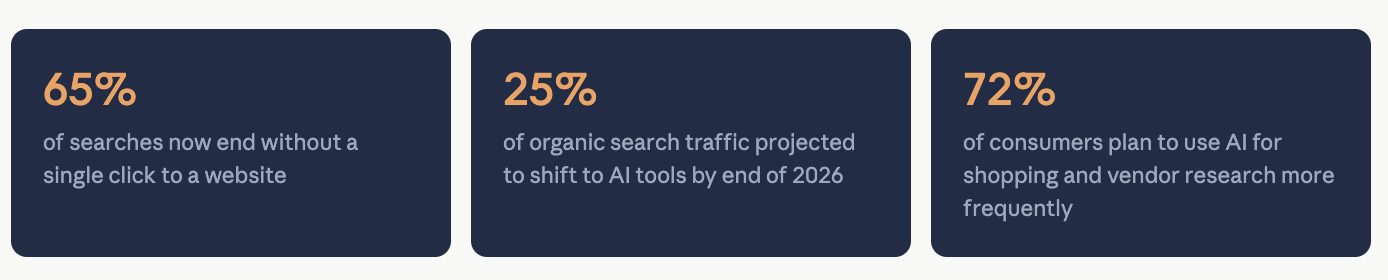
Those numbers aren't predictions anymore — they're already happening. And for small businesses that built their customer acquisition on organic search traffic, they represent a real and growing threat.
What's actually changing about how people search?
Three things are happening simultaneously, and they're compounding on each other.
1. People are asking questions, not typing keywords
Old search: "Columbus catering"
New search: "Who does fresh weekly meal prep for busy families near Columbus?"
The second query is how people actually talk. AI search tools are built for it. Most small business websites are still built for the first one. That gap is where customers get lost.
2. AI tools are answering — not just listing
Google's AI Overviews, ChatGPT, Perplexity, and others don't give you ten options. They give you one synthesized answer pulled from sources they've determined are credible, clear, and relevant. If your content isn't structured to be that source, you're invisible in that answer.
3. Local businesses are especially exposed
AI search tools increasingly personalize answers by location. "Best marketing agency near me" isn't pulling a national list — it's pulling businesses that have clearly communicated what they do, where they do it, and who they serve. Small and local businesses that haven't updated their content strategy for this are losing ground to competitors who have.
What does AEO actually look like in practice?
Here's the good news: AEO isn't a completely separate discipline from what you may already be doing with SEO. The same content that earns an AI citation is also more likely to rank well in traditional search. The difference is in how you structure and frame that content.
AI engines don't read websites the way humans do. They scan for specific signals: Is this content structured clearly? Does it answer a question directly? Is the business information consistent across the web? Is there evidence that other people trust this source?
Here are the five things that matter most for small businesses right now:
Answer questions explicitly in your content. Don't just describe what you do — answer the questions your customers actually ask. "How much does catering cost for 50 people?" "What's included in a weekly meal plan?" Write those questions as headings. Answer them in the first sentence below. AI engines pull those direct answers.
Be consistent everywhere your business is listed.Your name, address, phone number, and description should be identical on your website, Google Business Profile, Yelp, Facebook, and anywhere else you appear. AI tools cross-reference these to determine if a business is credible. Inconsistencies create doubt.
Claim and optimize your Google Business Profile.It's still one of the strongest signals for local AI search. Business category, service descriptions, hours, photos, and responses to reviews all feed into how AI tools understand and surface your business.
Get mentioned on other credible websites.AI tools look at who else is talking about you — local news, industry directories, partner websites, review platforms. A mention in the Columbus Dispatch or a feature on a local blog carries real weight in AI visibility.
Use plain language, not industry jargon.AI tools summarize content for general audiences. If your website is written in technical language your customers wouldn't use when asking a question, it's harder for AI to match your content to their queries. Write the way your best customer talks, not the way your industry talks.
A real example: how this plays out for a small business
Consider a catering company. Their website describes their services in broad terms — "full-service catering for events and corporate functions." That's accurate, but it won't surface when someone asks ChatGPT: "Who delivers fresh home-cooked meals for busy families in Columbus?"
The fix isn't a new website. It's adding a page — or even a section — that directly addresses that use case. Describes the customer. Explains what's included. Answers the obvious questions about price, pickup, frequency, and dietary options. Mentions Columbus specifically.
That content now exists for AI to find, summarize, and cite. The catering company didn't change what they offer. They changed how they described it — and suddenly they're showing up in a conversation they were invisible in before.
The underlying principle: You can't get cited by AI for something you haven't clearly written down. If you serve teachers, busy parents, or office managers — say so, explicitly, on your website. If you serve Columbus, say Columbus. Specificity is what AI engines reward.
What about traditional SEO — does it still matter?
Yes. SEO and AEO aren't competing — they're compounding. Well-structured content that answers questions directly ranks better in traditional search and gets cited more by AI engines. The practices overlap significantly.
The difference is emphasis. Traditional SEO prioritized keywords and backlinks. AEO prioritizes clarity, structure, and authority. A business that invests in AEO today is also building a stronger SEO foundation for tomorrow. There's no version of this where doing it hurts you.
What you want to avoid is doing neither — continuing to treat your website as a digital brochure while your customers' search behavior moves further toward AI-generated answers. That gap widens every month you wait.
Quick answers — common questions about AEO
How long does it take to see results from AEO?
Businesses with an existing website and some SEO foundation typically see initial improvements in AI visibility within 4–6 weeks of implementing AEO changes. Consistent citation patterns usually build over 3–6 months.
Does a small business need a technical person to do AEO?
Not for the basics. Most high-impact AEO work — adding FAQ sections, updating your Google Business Profile, rewriting service descriptions in plain language — requires good writing, not technical expertise. Schema markup helps and may require some assistance, but it's not the first thing to tackle.
What AI tools are actually pulling small business information?
ChatGPT, Google AI Overviews, Google AI Mode, Perplexity, Microsoft Copilot, and Apple's Siri (in some contexts) are the primary ones affecting small business visibility right now. Google remains the highest volume, but ChatGPT usage for local and purchasing decisions is growing fast.
Is AEO only relevant for businesses with a lot of website traffic?
No. AEO is actually more urgent for businesses with modest traffic — because those businesses are more dependent on new customers finding them through search and AI discovery, not word of mouth or repeat business alone.
The bottom line for small business owners
Search is changing faster than most small businesses are adapting. The businesses that show up in AI-generated answers in 2026 and 2027 are the ones building for it now — not because they have bigger budgets, but because they wrote down what they do, who they serve, and where they do it in a way that AI can understand.
That's not a technical problem. It's a clarity problem. And clarity is something any business can work on.
If you're not sure whether your current marketing is set up to be found by AI search — or whether it's even tracking revenue effectively enough to know what's working — that's exactly what a Block Watch diagnostic surfaces. In 45 minutes.